Frets
Fret dressing or a refret? How to choose and what it costs
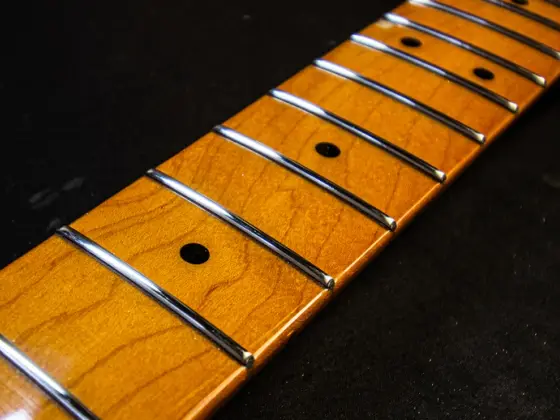
Frets are a wear item — like brake pads. A steel string works day after day against soft fret wire, and after years it leaves dents. The question isn’t “if” but “when” — and above all: is a dressing enough, or is it time for a refret?
There’s an honest answer, because it can be measured. Below is exactly what I check at the bench.
Symptoms of worn frets
- buzzing and “dead” spots at specific places on the neck, even though relief and action are set correctly,
- notes choking on bends — the string loses the note in a worn groove,
- dents visible under a light, most often under the plain strings in the first five frets and around your favourite licks,
- rough bends — the string scrapes instead of gliding,
- notes dying faster than they used to in the upper positions.
Important: buzzing has other causes too (neck relief, action set too low, seasonal wood movement) — which is why diagnosis starts with a setup, not a file. If the symptoms are point-specific, at particular frets — it’s almost certainly the frets.
Check the wear yourself in 2 minutes
- Under a light: tilt the guitar under a lamp — dents and flattened crowns show immediately.
- Fingernail test: run a nail along the fret crown — you’ll feel notches more clearly than you can see them.
- Rocker test: lay a short straight edge (a card works) across three neighbouring frets and try to rock it — rocking = unevenness.
- Bend test: bend a string at the suspect fret — if the note “chokes”, the crown is gone.
That’s enough for a first diagnosis. The dressing-vs-refret decision is made by measuring crown height — and that’s where the workshop begins.
When a dressing is enough
Dressing (levelling + crowning + polishing) solves the problem when:
- the dents are shallower than the fret’s height reserve,
- the issue is unevenness (a single high fret, factory sloppiness, a fret lifted by dry weather),
- the frets are matte and rough — polishing alone transforms the playing feel.
After a dressing the frets are levelled to within hundredths of a millimetre, re-crowned (crucial for intonation — the string must contact the top of the arc) and polished to a mirror. A dressing is a full-fledged repair, not a stopgap — whatever workshops that live off refrets may suggest. Done well, it serves for years.
My dressing (549 zł) includes a setup and conditioning of the instrument — after changing the fret geometry, the guitar needs setting up anyway.
When a refret is the only honest option
A refret becomes the right call when:
- dents reach deeper than the crown’s reserve — after levelling, the frets would be too low for comfortable playing,
- the frets have already been dressed once or twice and the reserve is gone,
- frets are loose in their slots or lifting at the ends,
- you want to change the specification anyway: taller/wider frets, or a switch to stainless steel.
A refret at my workshop is 799 zł — new frets to your specification, with a premium setup included. For comparison: refret prices in Poland start around 700 zł and exceed 1,600 zł (dressing: roughly 350–1,100 zł). I’m neither the cheapest nor the dearest — I’m here so the job is done once, properly.
Nickel or stainless steel?
- Nickel-silver (standard): the classic feel and tone, easier to work, wears naturally over the years. The best value for most players.
- Stainless steel: practically wear-proof, glassy glide on bends; a touch brighter attack (some hear it, some don’t) and higher labour cost. Makes sense for heavy playing, aggressive vibrato, and if you never want to revisit the topic of frets again.
No ideology: we’ll match it to your playing, not to fashion.
The decision tree in short
- Buzzing evenly everywhere? → setup first, not frets.
- Point-specific buzz/choking + visible dents? → frets.
- Shallow dents, tall frets, first wear? → dressing (549 zł).
- Deep pits, second/third time, loose frets, want stainless? → refret (799 zł).
- Don’t know how much reserve is left? → inspection (30 zł, included with a service) — I’ll measure and show you.
The fastest route to a reliable quote: send me a photo of your frets under a light on WhatsApp (+48 518 510 536) — I’ll assess whether it’s a dressing or a refret before you set out.
While the strings are off, consider a deep fretboard cleaning (59 zł) — the neck comes back like new in the same disassembly. And if the problem is tuning rather than frets — see “Guitar won’t stay in tune?”.
Frequently asked questions
How do I know my frets are worn?
The surest signs: visible dents under the strings (especially in the first five frets), buzzing and 'dead' notes despite a correct setup, notes choking on bends, and a matte, rough feel as the string drags across a bend. Tilt the guitar under a light — the wear is visible to the naked eye.
How many times can frets be dressed before a refret is needed?
Usually once or twice, depending on how deep the dents are and how tall the frets were to begin with. Every dressing removes material; when the crowns get too low, playing becomes tiring and bends lose precision — then a refret is due. At an inspection I measure fret height and tell you plainly how much life is left.
Is a stainless steel refret worth the money?
Stainless steel barely wears at all and gives a glassy feel on bends — but it costs more in material and labour, and some players hear a slightly brighter attack. For aggressive playing and frequent bends: yes, worth it. For occasional playing, classic nickel-silver is entirely sufficient.
Is a fret dressing worth it on a cheap guitar?
Often, yes — dressing plus a setup can turn a budget guitar into a surprisingly comfortable instrument, because fret finishing is usually the weakest part of cheap production runs. The limit is the refret: new frets worth more than the guitar only make sense for sentimental value. I'll tell you honestly at the inspection.
How much do fret dressing and a refret cost in Kraków?
At my workshop, dressing with polishing is 549 zł and a full refret is 799 zł — both include a setup (premium with the refret) and conditioning of the instrument. Across Poland, prices range from about 350 to 1,100 zł for a dressing and from 700 to over 1,600 zł for a refret.
Rather leave it in good hands?
I'll do it for you — properly.
Inspection and consultation 30 zł; included in the price when you book a service.