Setup
Evertune setup — how it works and how to adjust it
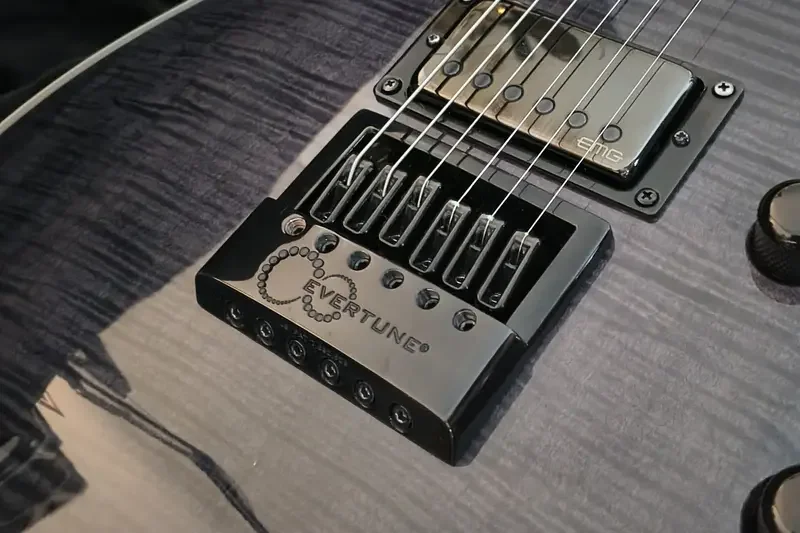
Evertune promises the end of tuning — and it truly delivers. On one condition: you have to understand the three working zones of its saddles. Without that, the bridge can be “unbearable” (as a famous forum thread title puts it): bends don’t work, the tuner “does nothing”, the feel goes strangely rubbery. All of those symptoms are one and the same thing — a string in the wrong zone.
How Evertune actually works
Inside the bridge, every string has its own spring that maintains constant tension. When temperature, humidity or string settling try to change the tension — the spring instantly compensates. The pitch stays put. No electronics, pure mechanics.
All the magic (and all the confusion) lies in where within its range the spring is working:
Zone 1 — too little tension
The spring “hangs” below its compensation range. The string behaves like on a normal bridge: the tuner works, but there’s no added stability. This is where you usually land right after fitting a new string.
Zone 2 — full compensation
The heart of the system. The spring cancels every tension change — weather, string settling… and unfortunately also your bends. Perfect for tight rhythm parts and recording, but bends and vibrato don’t work — the string snaps back to pitch as if glued. If your Evertune feels “rubbery”, you are exactly here.
Zone 3 — the “sweet spot”
Tune the string up to the top edge of zone 2 until the spring rests against the end of its range. Tuning is still protected against drift, but bends raise the pitch again — bends and vibrato work normally. This is how most players run it: plain strings in zone 3, wound strings in 2 or 3 to taste.
One sentence that solves 90% of the frustration: turn the key and watch the tuner — the moment the pitch starts to move as you tune up, you’ve entered zone 3.
Changing strings on an Evertune
- Slacken the string with the tuner until tension clearly drops (you leave the compensation range), then remove it from the saddle and the tuner as on any bridge.
- Fit the new string, wind it properly (2–3 wraps) and tune it up into zone 2 — you’ll know you’re there when the pitch stops responding to the key.
- Stretch the string by hand; notice that the tuning… doesn’t drift. Not a bug — that’s Evertune.
- Want bends on that string? Keep tuning up until the tuner responds again — you’re in zone 3.
Change strings one at a time, and don’t panic when the tuner “freezes” — you’re simply working in zone 2.
Changing tuning or string gauge
Drop C? An 11-56 set? Evertune will handle it, but the springs have a finite range — bigger tension changes require re-setting each saddle’s working range with a hex key (spring tension adjustment), then setting the zones again. On top of that comes standard guitar physics: different tension = different neck relief, action and intonation. That’s full-setup (269 zł) territory — once, done properly.
Action and intonation with Evertune
String height and intonation are adjusted at the bridge saddles with a hex key — much like conventional bridges, just in the tighter geometry of the Evertune housing. A practical order: neck relief → action → zones/tuning → intonation. After any action change, re-check the zones: moving a saddle shifts the spring’s working point.
Common symptoms — cheat sheet
| Symptom | What’s happening | Fix |
|---|---|---|
| Key turns, pitch stays | string in zone 2 | that’s normal; want bends → tune up to zone 3 |
| Bends “don’t work”, rubbery feel | zone 2 | tune up to zone 3 |
| Tuning drifts despite Evertune | string in zone 1 (too slack) | tune up into zone 2/3 |
| String breaks at the bridge | sharp saddle slot edge | chamfer/replace at the workshop |
| Everything’s off after a gauge change | spring range outside the new tension | range adjustment + full setup |
When the workshop earns its keep
Day-to-day Evertune care is simpler than the legend says — you’ll manage the zones with a tuner and a hex key. What lands on my bench instead: tuning and gauge changes (re-setting every spring’s range), action + intonation after changes, breaking strings, Evertune installation (routing), and guitars that are “impossible to set up” after a series of experiments. A premium Evertune setup is 269 zł — inspection included. Floyd Rose guitars have their own guide.
Frequently asked questions
Does Evertune limit bends and vibrato?
Only when the saddle works in the compensation zone (zone 2) — there, the bridge by definition cancels every tension change, including your bend. Tune the string up into zone 3 (the 'sweet spot') and bends and vibrato work normally, with tuning stability preserved.
Why doesn't turning the tuner change the pitch?
Because the string is in zone 2: the Evertune spring compensates tension changes, so turning the key only moves the spring's working point, not the pitch. That's not a fault — that's what compensation means. In this zone you set the pitch once and the bridge guards it.
Does Evertune need frequent adjustment?
The system itself holds tuning for years, but wood still moves: after a season change, a new string gauge or a different tuning it's worth correcting the zones and action. Owners typically make small hex-key touch-ups every few months; a full setup — as with any guitar — when conditions change.
Can Evertune be fitted to my guitar?
Technically to most fixed-bridge electrics — but it requires routing a cavity in the body, so it's an irreversible modification and a job for a workshop with a router and templates. I advise on this individually at an inspection.
How much does an Evertune setup cost in Kraków?
At my workshop, 269 zł — a full premium setup: strings, zone and tuning adjustment, neck relief, action, intonation, plus cleaning and conditioning. Inspection and consultation included.
Rather leave it in good hands?
I'll do it for you — properly.
Inspection and consultation 30 zł; included in the price when you book a service.