Setup
How to set up a Floyd Rose guitar? Step-by-step guide
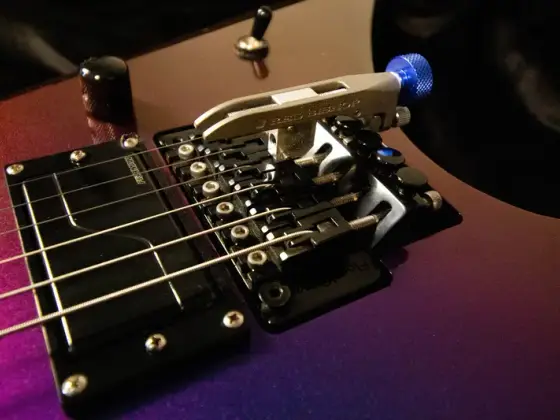
The Floyd Rose is the most loved and most cursed bridge in the world. It does things a fixed bridge can only dream of — and it can turn a string change into an hour of frustration if you don’t understand the one principle the whole system stands on.
How a Floyd Rose works (understand this and the rest is easy)
A floating bridge hangs in equilibrium between two forces: string tension (pulling up and forward) and the springs in the back cavity (pulling down and back). When the balance is perfect, the base plate sits parallel to the body.
Everything that drives people mad follows from this: change anything on one side of the equation — string gauge, tuning, number of springs — and the whole system shifts. You tune the low E, the high E drifts. That’s not your guitar being broken; that’s physics.
Before you start: tools and honest timing
- a set of hex keys (typically 3 mm for the locking nut and saddles, 2.5 mm for fine tuners — model-dependent),
- a Phillips screwdriver for the spring claw,
- tuner, string cutters,
- something to support the bridge: an AA battery, an eraser, a piece of cork,
- time: your first full DIY setup realistically takes 1.5–2 h. A string change without a tension change — 30–40 minutes.
String change, step by step
- Loosen the locking nut (the three clamps at the headstock) — hex key, no force.
- Support the bridge from behind (an AA battery between the plate and the body) — it won’t “sink” when tension drops.
- Change strings one at a time — you keep tension and balance.
- Clip the ball end and lock the string in the bridge saddle (hex — firm, not brutal).
- Pass the string through the nut, wind onto the tuner (2–3 wraps), rough-tune.
- With the full set on: stretch the strings (gentle pulls over the 12th fret), retune, repeat.
- Remove the support, retune again — a few iterations until the tuning stops drifting.
- Clamp the locking nut — from now on you tune only with the fine tuners.
Pro tip: set the fine tuners to the middle of their range before restringing — you’ll have margin both ways.
Levelling the bridge (claw and springs)
If, once tuned, the plate tilts upward — the springs are losing: tighten both claw screws in the cavity (quarter turns, alternating with re-tuning). If it sinks into the body — loosen them. The goal: plate parallel to the body with the guitar in tune.
Two springs are fine for standard gauges (9-42, 10-46); heavier sets and lower tunings usually need a third.
String action
On a Floyd Rose you set string height with the two pivot posts the bridge rests on — not with individual saddles. Turn in small steps (⅛ turn) with strings slackened, or gently under tension. Remember: changing bridge height slightly changes intonation and balance too — finish by re-tuning.
Intonation — the hardest part
The test: open string vs the same note at the 12th fret. Sharp at the fret = saddle too close to the neck; flat = too far.
On a Floyd Rose the saddle is bolted to the plate — to move it you loosen the mounting bolt with the string at tension (or slacken the string, move the saddle, retune and measure again). It’s tedious, iterative work and the most common reason FR guitars land on my bench “after a DIY setup”. Without practice or a helper tool (The Key etc.), leave this step for last — or leave it to me.
Changing tuning or gauge — why everything drifts
The classic real-world scenario: you buy a heavier set for drop C and suddenly nothing works. The order that saves your nerves:
- fit the new strings (as above), tune to the target tuning,
- level the bridge with the claw (this takes several iterations — normal),
- check neck relief (different tension = different truss-rod load; this is full-setup territory),
- correct the action at the pivots,
- intonation last.
Steps 3–5 are exactly the scope of a premium setup (269 zł) — when changing tuning, I recommend doing it once, properly, instead of chasing the balance for weeks.
Common problems — cheat sheet
| Symptom | Most likely cause | Fix |
|---|---|---|
| Bridge tilts up | springs too weak / heavier strings | tighten claw, maybe a third spring |
| Bridge sinks | springs too strong / lighter strings | loosen claw |
| Drifts after whammy use | friction at nut or knife edges | clamp the nut; worn edges/nut → workshop |
| ”Ping” while tuning | string binding in the nut | slot correction / nut replacement |
| Strings break at the bridge | sharp saddle edges | chamfer/replace parts at the workshop |
| Sour notes up the neck | intonation after action/gauge change | set intonation (step above) |
More on tuning stability itself in the guide “Guitar won’t stay in tune? 8 causes”.
When to give up on DIY
String changes and claw balance — you’ve got this, that’s what this guide is for. The line of sanity runs at: worn knife edges, saddle replacement, nut slot correction, intonation that “won’t converge”, and guitars after a series of failed experiments. For those, come to Limanowskiego — a premium setup for Floyd Rose / Ibanez Edge / Kahler / Bigsby / Evertune is 269 zł, inspection included.
Frequently asked questions
Can a Floyd Rose be blocked permanently, and is it worth it?
Yes — with a wood block in the spring cavity or a ready-made stabiliser. You gain tuning stability and easier string changes, you lose upward whammy work. If you never use the tremolo, blocking is often the most sensible 'setup'; if you do use it — a properly balanced bridge is the better answer.
Why does my Floyd Rose go out of tune after using the bar?
Usually friction: strings binding at the nut (if the locking nut isn't tightened or the slots are worn) or on the bridge's knife edges. Worn knife edges and posts are the natural suspects on older guitars — no adjustment will help until those parts are repaired or replaced.
I changed string gauge and the bridge lifted — what now?
That's normal: a heavier set pulls harder and lifts the bridge. Tighten the spring-claw screws in the back cavity (or add a spring), alternating with re-tuning, until the base plate sits parallel again. After a big tension change it's worth checking action and intonation too.
How much does a Floyd Rose setup cost at a luthier?
At my workshop, a premium setup for a Floyd Rose guitar (also Ibanez Edge, Kahler, Bigsby and Evertune) is 269 zł: strings, bridge balancing, neck relief, action, intonation, plus cleaning and conditioning. Inspection and consultation are included.
How often should a Floyd Rose guitar be set up?
With the same string set and tuning — usually a setup at the change of season is enough (wood moves in winter and summer). Mandatory after every change of string gauge or tuning, because the whole system's balance changes.
Rather leave it in good hands?
I'll do it for you — properly.
Inspection and consultation 30 zł; included in the price when you book a service.